


Protection You Can Trust
Safety Devices for NDIS Support Workers
Protection You Can Trust
Safety Devices for NDIS Support Workers

TABLE OF CONTENT:
- Why NDIS Support Workers Need a Dedicated Safety Device
- Key Features of an NDIS‑Focused Safety Device
- The Legal Context: Regulators Are Watching & Court Cost Can Be Millions
- Types of Safety Solutions for Different NDIS Roles
- How SafeTCard Supports NDIS Providers
- NDIS Worker Safety FAQs
Every day, NDIS support workers across Australia step into unpredictable situations. A routine home visit can escalate without warning. A shift in supported independent living (SIL) can turn volatile. A community outing can become a medical emergency.
NDIS staff and contracted workers regularly report being verbally abused, threatened, stalked and, in some cases, physically assaulted while performing their duties. Incidents have included threats of violence, suicide threats directed at staff, property damage, and lockdowns of service centres.
Worker‑related violence and aggression is defined as when an NDIS worker is abused, threatened or assaulted in their workplace or while they are working. The NDIS Commission has emphasised the importance of reducing violence against workers, including the launch of initiatives aimed at improving worker safety and promoting violence prevention.
A dedicated safety device for NDIS support workers provides the critical link between a worker in distress and the help they need, instantly, discreetly, and without relying on a mobile phone.

Why NDIS Support Workers Need a Dedicated Safety Device
The NDIS Commission acknowledges that there are unique risk and safety issues that need to be considered when NDIS supports and services take place in a participant’s home. Detailed safety assessment and planning can help avoid situations that increase the risk of a violent incident.
Yet many support workers are sent into the field with nothing more than a mobile phone and a check‑in policy. Here’s why that’s not enough:
- A phone can be taken or dropped. In a confrontation, the first thing an aggressor often does is remove the victim’s phone.
- A worker may be unable to speak. During a medical emergency or physical assault, calling for help may not be possible.
- A phone doesn’t escalate automatically. If a worker misses a check‑in, someone has to notice. And that someone may be in a meeting, on another call, or off duty.
- Services delivered in private homes or without others present can increase risk for both participants and workers.
A purpose‑built safety device removes these gaps entirely.
NDIS workers have the right to feel safe when they are at work, and the right to report workplace violence to their employers, the NDIS or the NDIS Commission. NDIS providers are responsible for providing safe workplaces by protecting their workers from the risk of violence and aggression.
Key Features of an NDIS‑Focused Safety Device
When choosing a safety solution for your NDIS workforce, look for these essential features:
- GPS‑Enabled Duress Alarm: one press sends your exact location to a 24/7 monitoring centre. No dialling. No explaining. Just help on the way.
- Man‑Down: triggers an alert automatically if you fall, become incapacitated, or fail to move – critical for SIL shifts and home visits.
- Scheduled Welfare Checks: pre‑programmed check‑ins at set times. If you fail to respond, the system escalates without waiting for anyone to notice.
- Discrete Activation: hidden button lets you signal distress without escalating an already tense situation.
- Two‑Way Communication: monitoring centre operators can speak through the device to assess the situation and coordinate emergency services.
- Auditable Logs: every alert, check‑in, and response is recorded, providing clear evidence for WHS compliance and incident investigations.
The Legal Context: Regulators Are Watching & Court Cost Can Be Millions
The NDIS Commission has made it clear that NDIS providers are responsible for providing safe workplaces by protecting their workers from the risk of violence and aggression. This includes:
- Assessing safety risks to workers, particularly during home visits and SIL shifts
- Providing quality and safe NDIS supports and services
- Taking steps to prevent and respond to incidents, including identifying and controlling risks
- Reporting worker‑related violence

NDIS workers have WHS responsibilities too, including taking reasonable care of themselves and following health and safety instructions from their employer.
The consequences of failing to protect workers can be severe. In a landmark case, the Federal Court imposed a record $2.5 million penalty against an NDIS provider for failing to keep participants and support workers safe. The Court found that the home was not a safe environment, noting abuse was not managed, assessed or responded to adequately or appropriately. Support workers were subjected to harm from other participants, including being bitten, spat on and physically hit.
In another case, SafeWork SA prosecuted a disability support provider after a worker was sexually assaulted by a client. The court documents alleged the provider did not provide or require the worker to wear a personal duress alarm, such as a belt clip personal alarm. The provider ultimately pleaded guilty to failing to provide a safe system at work. The worker had been in the industry for 30 years before the offence “turned her workplace into a place of horror”.
Providers who fail to comply with their obligations face serious consequences. The NDIS Commission has stated it “will not hesitate to use every power, including civil proceedings, to protect the human rights of people with disability”. Ensuring worker safety is not just good practice, it’s increasingly becoming a regulatory expectation.
Types of Safety Solutions for Different NDIS Roles
Different NDIS roles have different risk profiles. Here’s a guide to choosing the right solution:
| Role | Primary Risks | Recommended Solution |
|---|---|---|
| Home Visit Support Worker | Isolated entry into unfamiliar homes, potential for escalation | Discrete GPS pendant with man down detection & scheduled check ins |
| SIL Night Shift Worker | Working alone overnight, potential for medical emergencies | 24/7 monitored device with fall detection & two way communication |
| Community Access Worker | Public spaces, transport, potential for aggression | Wearable duress alarm with discreet activation |
| Remote/Regional Worker | Limited backup, mobile black spots | Satellite ready device with extended battery life |
| Behaviour Support Practitioner | High risk participant interactions | Fast activation duress with immediate monitoring centre escalation |
The NDIS Commission provides home safety checklists and risk assessment tools for participants and workers to complete and identify actions. These tools help you understand the safety risks in individual participant’s homes and plan accordingly.
When working in homes with a history of risk or when you’re alone or a remote support worker, use safety alert guidance from the Commission.
How SafeTCard Supports NDIS Providers
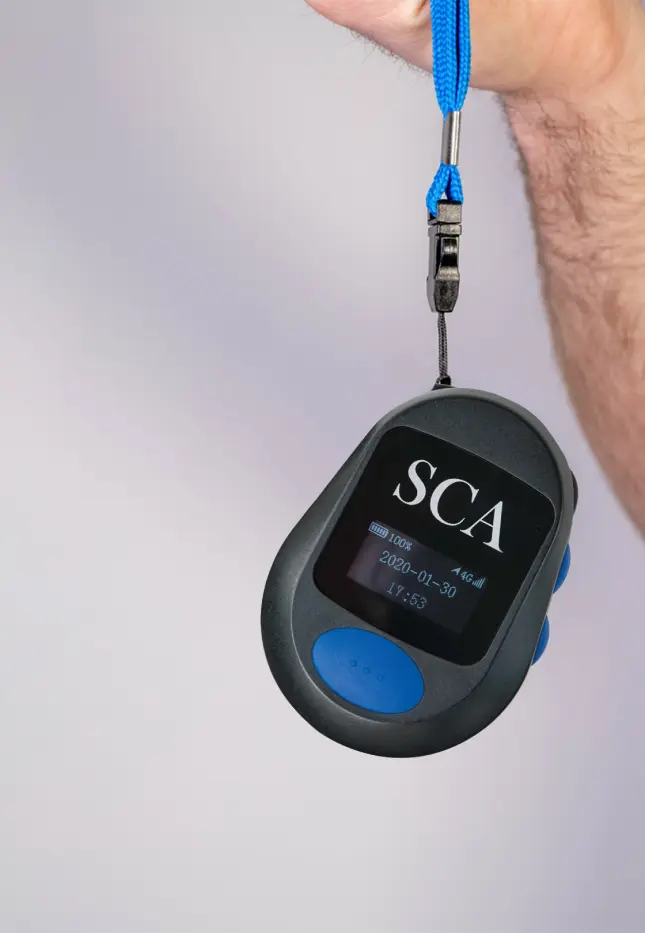
SafeTCard provides personal alarms specifically designed for frontline workers. Our devices are:
- Discrete: small, professional, and unobtrusive. No stigma, no unnecessary attention.
- Reliable: backed by a Grade A1 ASIAL‑accredited monitoring centre with 24/7 Australian‑based operators.
- Backed by a Safety Net: automated escalation, man‑down detection, GPS tracking, and satellite‑ready options for remote work.
- Auditable: complete logs for WHS compliance and incident investigations.
Our monitoring centre operates with redundant power, multiple backup communications, and a strict zero-cloud, zero‑offshoring security policy. When a worker triggers an alert, our operators can:
- Speak directly to the worker through the device
- Assess the situation in real time
- Coordinate with emergency services and dispatch help to the exact location
- Escalate through pre-defined chains if the worker cannot respond.
Protect Your NDIS Workforce Today
Your support workers are your greatest asset. They deserve to feel safe on every shift, whether they’re in a participant’s home, a SIL facility, or out in the community.
NDIS workers have the right to feel safe when they are at work. A dedicated personal alarm is a small investment that delivers peace of mind for workers, their families, and their employers.
Contact SafeTCard today to discuss a tailored safety device solution for your NDIS support workers.
NDIS Worker Safety FAQs
- General Safety Questions
A personal duress alarm is a discrete, wearable device that allows a support worker to instantly summon help in an emergency. When activated, it sends the worker’s GPS location to a 24/7 monitoring centre, which can coordinate with emergency services. Unlike a mobile phone, a duress alarm can be activated without dialling or speaking – critical in moments of crisis.
Yes. Under the model WHS laws, NDIS providers (as PCBUs) have a primary duty to ensure the health and safety of workers. The NDIS Commission states that NDIS providers are responsible for providing safe workplaces by protecting their workers from the risk of violence and aggression. In a prosecution case, SafeWork SA alleged a provider failed to require a worker to wear a personal duress alarm.
Registered NDIS providers must follow the NDIS Practice Standards, which include requirements for a documented risk management system that effectively manages work health and safety risks. The Commission has also introduced a new Supported Independent Living (SIL) module to the Practice Standards.
- Risk Assessment Questions
The NDIS Commission recommends using the Home Safety Checklist and Home Safety Risk Assessment developed by SafeWork NSW. These tools help identify risks such as aggressive behaviour, unsafe environments, and situations that increase the likelihood of violence.
Workers should have a clear escalation protocol, including access to a duress alarm, scheduled welfare checks, and a supervisor contact. NDIS workers have the right to feel safe when they are at work, and the right to report workplace violence. If a worker feels unsafe, they should not hesitate to activate their safety device and leave the situation.
- Safety Device Questions
Look for GPS tracking, 24/7 professional monitoring, man‑down detection (triggers automatically if you fall or become incapacitated), discrete activation options, two‑way communication, and auditable logs for WHS compliance.
Some devices offer satellite‑ready capability for remote and regional work where mobile coverage may be unreliable.
Yes. SIL facilities present unique risks, and a duress alarm provides workers with a direct line to help – particularly during night shifts or when working alone. The Federal Court found in one case that support workers were subjected to harm in a SIL home, including being bitten, spat on and physically hit.
- Incident Reporting Questions
Workers should report the incident to their employer and, where appropriate, to the NDIS Commission. Providers are required to report serious incidents within required timeframes – failure to do so can result in significant penalties. Workers can also report directly to the NDIS Commission.
In one case, a provider was ordered to pay $2.5 million in penalties after admitting 1,811 contraventions of the Reportable Incident Rules for failing to report serious incidents. The NDIS Commission has stated it “will not hesitate to use every power – including civil proceedings – to protect the human rights of people with disability”.
- Incident Reporting Questions
NDIS workers have WHS responsibilities, including taking reasonable care of themselves and not doing anything that would affect the health and safety of others at work. They should also follow their employer’s health and safety instructions and participate in training.
NDIS workers have the right to feel safe when they are at work, and the right to report workplace violence to their employers, the NDIS or the NDIS Commission. Workers also have the right to stop work if they reasonably believe they are in immediate danger.
